Pain, pulling, an opening, drainage, painful intercourse, or new difficulty controlling gas or stool months after childbirth or an earlier repair deserves a structural assessment rather than repeated self-treatment. You will learn how surgeons distinguish scar revision from perineal reconstruction, sphincter repair, and fistula surgery, which tests guide the choice, and when urgent care is needed.
Key takeaways
- Seek assessment for pain, drainage, bleeding, or wound breakdown after healing.
- Examination distinguishes scar problems from infection, fistula, fissure, or sphincter injury.
- Ask whether repair, scar excision, or sphincter reconstruction addresses the underlying defect.
- Confirm recovery time, continence risks, wound care, and follow-up before surgery.
When an old perineal tear needs a new assessment
Pain, pulling, or painful intercourse that persists beyond the initial healing period—usually six to twelve weeks after childbirth or an earlier repair—deserves examination. So do a visible notch, opening, wound breakdown, recurrent infection, drainage, bleeding, or a perineum that never fully heals.
Faecal urgency, leakage, soiling, loss of flatus control, or difficulty distinguishing gas from stool warrants assessment for an anal-sphincter injury, even when the skin scar looks small.
| Finding | Why it matters | Action |
|---|---|---|
| Tight, painful scar or painful intercourse | Scar restriction or a separated perineal body | Arrange a specialist review |
| Leakage, urgency, soiling, or poor gas control | Possible occult anal-sphincter defect | Arrange prompt assessment |
| Drainage, recurrent infection, or a small opening | Possible fistula or wound breakdown | Seek review rather than repeated self-treatment |
| Enlarging, firm, ulcerated, or bleeding lesion | Infection, inflammatory disease, or rarely malignancy | Arrange examination and possible biopsy |
Seek urgent care for rapidly worsening pain or swelling, fever with redness, pus or foul-smelling drainage, heavy bleeding, faintness, inability to pass urine, or a wound that opens suddenly. Do not assume excision alone will solve the problem: excision removes abnormal scar or tissue, while repair reconstructs separated viable tissue.
A consultation for perineal tear repair or excision in Girgaon should name the target operation—scar revision, perineal-body reconstruction, sphincteroplasty, fistula repair, or biopsy. Search terms such as perineal tear repair in Girgaon describe a location, not a diagnosis.
How doctors separate a tear problem from other conditions
A scar problem causes focal tenderness, pulling, tightness, or pain during intercourse at the old tear site. A request for perineal tear repair Girgaon should identify the structure involved, because scar excision will not correct a hidden anal-sphincter defect.
A clinician separates the possibilities by locating pain, bleeding, drainage, bulging, and loss of control:
- Perineal scar: a tender, firm ridge, notch, skin bridge, or separated perineal body at the previous repair site; bowel control may remain normal.
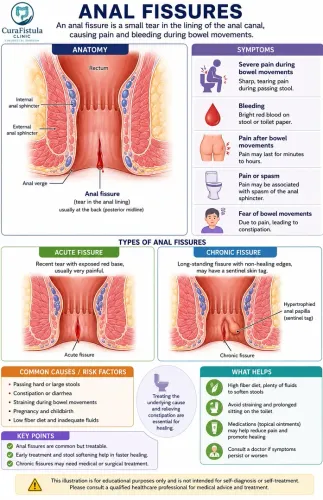
- Anal fissure: sharp, knife-like pain during and after bowel movements, with a small streak of bright-red blood at the anal edge.
- Fistula: a persistent opening, pus, foul drainage, recurrent abscess, or gas or stool passing through the perineal or vaginal area.
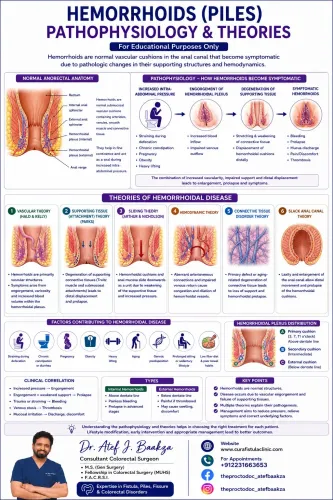
- Hemorrhoid: itching, bright-red bleeding, or a lump at the anus that swells or protrudes, without a nonhealing perineal wound.
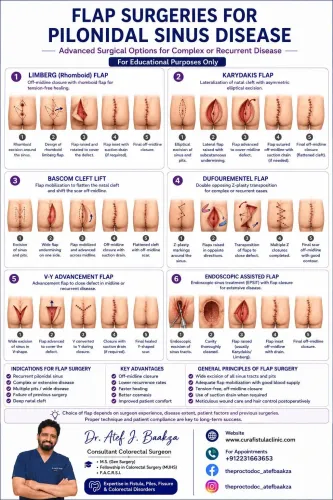
- Pilonidal sinus: pits or a draining lump in the midline cleft above the anus, rather than at the vaginal opening or perineal scar.
- Vaginal or rectal prolapse: pressure and a bulge that appears through the vagina or anus, especially while standing or straining.
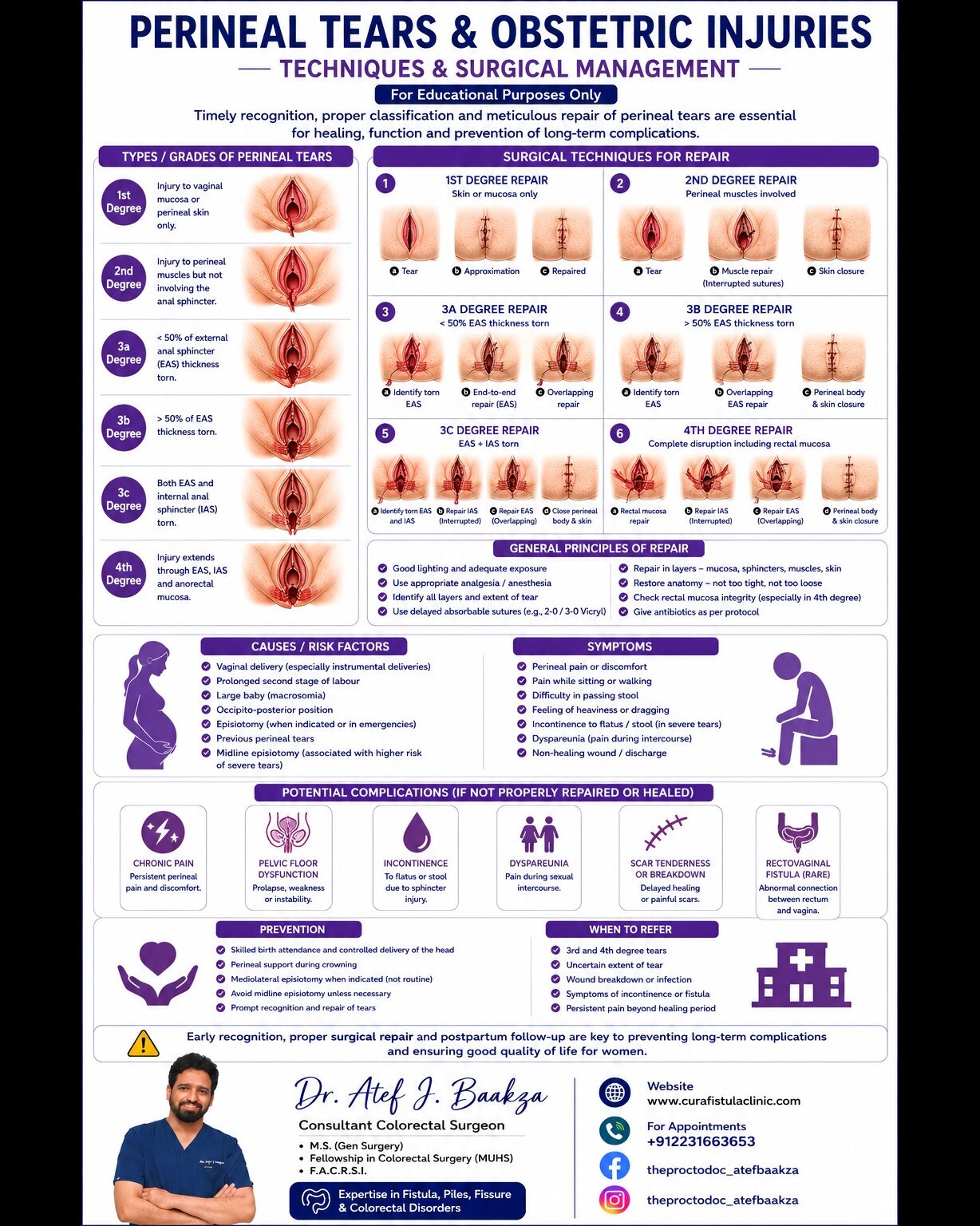
- Anal-sphincter injury: urgency, inability to hold gas, soiling, leakage, or difficulty distinguishing gas from stool. A normal-looking scar does not exclude it.
Inspection and a careful digital examination help locate the defect; persistent drainage, bleeding, or new incontinence needs prompt review rather than repeated self-treatment.
What examination and tests determine the correct operation
The phrase perineal tear repair or excision Girgaon describes a location, not a single operation. Assessment starts with your symptoms, childbirth or repair history, and a careful inspection of the perineal skin, vaginal opening, scar, perineal body, and any discharge, bleeding, ulceration, or wound breakdown.
A digital rectal examination checks sphincter tone, squeeze strength, tenderness, a gap in the muscle, a fistula opening, and rectal or vaginal bulging. It helps show whether symptoms reflect a painful scar, pelvic-floor spasm, or an anal-sphincter injury, but fingers cannot define every hidden defect.
- Endoanal ultrasound is useful when gas or stool leakage, urgency, or weak squeeze suggests an occult sphincter tear. It shows whether the external or internal sphincter is separated and how much muscle remains for reconstruction.
- Anal manometry measures resting and squeeze pressures. Request it when continence symptoms do not match the visible scar, or when the surgeon must distinguish weak muscle from poor coordination or sensory problems.
- Biopsy, culture, or other imaging is needed for a nonhealing, enlarging, bleeding, ulcerated, or unusually firm lesion, because infection, inflammatory disease, fistula, or rarely malignancy can mimic an old tear.
The report should name the structure involved: scar, perineal body, anal sphincter, rectovaginal septum, or vaginal opening. Scar excision removes abnormal tissue; it cannot restore a damaged sphincter. Discuss future pregnancy and delivery after the findings are available, not from the scar’s appearance alone.
Repair, scar excision, or sphincter reconstruction: how the choice is made
Conservative treatment is enough when the wound is fully closed, the perineal body remains intact, and symptoms are mild without infection, drainage, a visible gap, or loss of gas or stool control. Pelvic-floor physiotherapy, stool-softening, treatment of constipation, and carefully supervised scar care can reduce tightness and pain.
Excision helps when one localized scar causes pulling, painful intercourse, tenderness, recurrent breakdown, or contains a retained suture or abnormal nonhealing tissue. The surgeon removes the unhealthy area, sends suspicious tissue for biopsy, and closes the remaining healthy edges. Excision alone will not repair a damaged anal sphincter or deep pelvic-floor injury.
An excision Girgaon search therefore identifies a location, not a complete treatment plan.
Reconstruction is chosen when examination and testing show a structural defect:
- Perineal-body reconstruction joins separated muscles and connective tissue when a notch, opening, or poor support remains.
- Sphincteroplasty identifies and re-approximates torn anal-sphincter ends, often with an overlapping repair, for troublesome incontinence with a demonstrable defect.
- Rectovaginal-septum repair closes a passage, weak partition, or fistula between the rectum and vagina.
- Vaginal-opening repair restores distorted or narrowed edges causing gaping, painful intercourse, or wound breakdown.
A scar’s appearance does not prove the injury’s depth. Discuss future pregnancy before reconstruction, using symptoms, examination, endoanal ultrasound, and manometry to plan delivery and reduce the chance of another sphincter injury.
Questions to ask before perineal tear surgery in Girgaon
Ask for the exact structure being treated before consenting to perineal tear surgery Girgaon. “Repair” is too vague: scar revision, perineal-body reconstruction, sphincteroplasty, fistula repair, and excision with biopsy have different goals and recovery demands.
| Option | What it does | What to ask |
|---|---|---|
| Scar excision or revision | Removes painful, tight, or abnormal scar before closure | Will this address the pain source, or is muscle, nerve, or infection involved? |
| Perineal-body reconstruction | Rebuilds separated or weak tissue between the vagina and anus | Which layers will be restored, and how will wound breakdown be prevented? |
| Sphincteroplasty | Repairs a documented anal-sphincter defect | Do examination, endoanal ultrasound, or manometry show a defect? |
| Fistula repair or biopsy | Treats an abnormal tract or investigates a nonhealing lesion | Will culture, imaging, or tissue testing be needed first? |
Ask how many operations of the proposed type the surgeon performs, who manages complications, and what result will be measured: pain, intercourse, wound closure, gas control, or stool continence. Dr. Atef J. Baakza can be asked to explain which finding makes repair preferable to excision Girgaon patients are considering.
Get written recovery instructions covering wound cleaning, sitting, bathing, bowel-softening medication, lifting, sex, driving, work, and warning signs. Ask who reviews drainage, fever, opening, or worsening pain.
Discuss another pregnancy before surgery. Ask how current continence, examination, endoanal-ultrasound findings, and manometry affect delivery planning, since a later vaginal birth can cause another sphincter injury. A scar’s appearance alone cannot answer that question.
Related service
Perineal Tear - Perineal Tear Repairs Perineal Tear - Perineal Tear Repairs Perineal Tear – Perineal Tear Repairs by Dr. Atef J. Baakza Understanding Perineal Tears A perineal tear refers to an injury or tear that occurs in... View service → |
Frequently asked questions
When does an old perineal tear need reassessment?
Arrange an examination when pain, pulling, painful intercourse, drainage, bleeding, infection, wound breakdown, or incomplete healing persists beyond the initial six-to-twelve-week healing period.
How do doctors distinguish a tear problem from other conditions?
They review childbirth or surgical history, examine the scar and perineum, and assess for infection, fistula, fissure, abscess, wound separation, or anal sphincter injury.
What determines whether you need repair or scar excision?
The operation depends on whether the problem is a structural gap, excess scar tissue, wound breakdown, infection, or damaged anal sphincter muscle.
What should you ask before perineal tear surgery in Girgaon?
Ask which defect is being treated, why the proposed operation is suitable, what tests are needed, expected recovery, wound-care requirements, continence risks, and follow-up arrangements.
Keywords